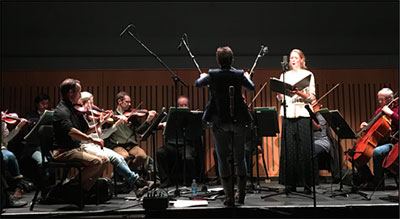
My Hazara People was commissioned by Cayenna Ponchione and the Orchestra of St John’s, for the orchestra’s 2018-2019 Displaced Voices project, which amplifies the voices of young refugees through music. The work was premiered by Charlotte Tetley and the Orchestra of St. Johns (conducted by Cayenna Ponchione) at the OSJ’s 50th Anniversary Concert at Dorchester Abbey on 30 November 2018. I am so privileged that Cayenna and the OSJ are performing the work 2 further times at King’s Place, London (19 January) and Somerville College, Oxford (18 January): ’Young refugees from an award-winning poetry programme perform their own spoken word over orchestral backing tracks written in collaboration with composer Toby Young. Alongside these performances, Charlotte Tetley sings settings of poems including My Hazara People by Sadie Harrison with words by prize-winning refugee poet Shukria Rezaei, with a special performance by Play for Progress, a London-based charity that delivers therapeutic and educational music programmes for unaccompanied child refugees. The concert programme will also include Barber’s stirring Adagio for Strings and Shostakovich’s arresting Chamber Symphony for Strings in C minor, which the composer dedicated to ‘the memory of victims of fascism and war’.’
Programme note:
My Hazara People is a setting of two texts, the title work by Shukria Rezaei and Lalai, lalai, bobe bacha shikar rafta (Baby’s father went hunting), a traditional Hazari lullaby. Although their characters are entirely different, the two poems share much in common. The importance of family and home and the connection with country and heritage are at the centre of both. Shukria’s poem is a direct expression of love and despair for Afghanistan with intimate moments of terror – a cup falling from her mother’s hand during an explosion, her aunt fainting – set against the suffering of Hazaras across the world. In the context of this devastating contemporary experience Lalai lalai is nostalgic and poignant – open gates, straw latches, a sleeping child. The tune of the lullaby is heard in two highly contrasted versions. For Shukria’s words it is dark and restrained, a repeating rhythm illustrating the Hazara’s seemingly never-ending pain, and for Lalai lalai it is bright and joyful with sounds of the hunt, a crackling fire and a gentle chorus as the child is rocked. A further thread runs through the music – a quotation of my favourite traditional Afghan Herati lullaby Allah Hu (God is great), reflecting Shukria’s reference to her people’s religious heritage. I have adapted the text at the end of Lalai Lalai to bring it into the Shukria’s world, a reminder that each innocent person caught up in conflict is a mother, a brother, a sister, a father, a daughter….kids like us.