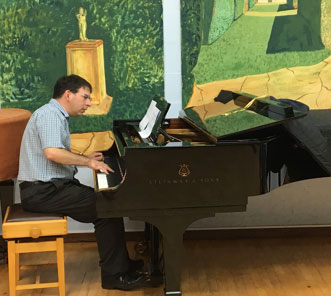
I am so indebted to Duncan for his several performances of my music over the past decade and am delighted that he will be premiering ‘..on a name..’ at Sherborne School for Girls on 12 September.
Programme note: These miniatures illustrate three nineteenth century texts regarding the villages of Church Honeybourne and Cow Honeybourne, (now united within the boundary of Worcestershire). The village names are derived from Old English (hunig – honey, and burna – stream), meaning places on the stream by which honey is found. ‘Cow’ comes from calu, meaning bare, or lacking vegetation. Duncan Honeybourne is a great researcher of history and genealogy as well as the finest of pianists, and I am pleased to dedicate this set of historically-derived pieces to him by way of thanks for his great support of my music. His name is found as a cipher throughout the pieces.
I – ‘the church long in ruins’
‘HONEYBOURNE (COW), a parish in the upper division of the hundred of KIFTSGATE, county of GLOUCESTER, 4 miles (N.W.) of Chipping-Campden, containing 333 inhabitants. The living was annexed to the perpetual curacy of Church-Honeybourne after the dissolution. The church, long in ruins, has been converted into houses for the poor, but the tower is still entire.’(Lewis, S., A Topographical Dictionary of England in Four Volumes, S. Lewis & Company, 1831)
II – ‘disturbing the bodies of the dead’
‘The Reverend William Baldwin Bonaker became curate at Honeybourne in 1813 and vicar in 1817, a living he held until his death in 1869. He was considered to be a generally uncaring vicar…violating the churchyard, by ‘indecently and irreverently digging the ground in the churchyard and thereby disturbing the bodies of dead therein’ in order to move earth from there to his garden.’ (Haggard, J., Reports of Cases Argued & Determined in the Ecclesiastical Courts at Doctors’ Commons, & in the High Court of Delegates, W.Benning, 1829)
III – ‘wilful murder against some person unknown’
‘On June 22nd, 1809, a young woman named Harris, residing at Honeybourne, was called up from her bed in the night, and on opening the door she was attacked by some person with a pitchfork, dragged to a horsepond, and drowned. Suspicion fell on a young man by whom she was pregnant, but the jury returned a verdict of ‘wilful murder against some person unknown’ and the murderer was never discovered.’ (Noakes, J., Guide to Worcestershire, Longman & Co., London, 1868)