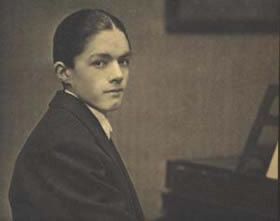
I am delighted that Duncan is performing Shadows to inaugurate the new piano at Gillingham Methodist Church on 12 April 2018. Yorkshire composer William Baines died in 1922 at the age of 23 but left behind a substantial catalogue of over 150 works. Likened to that of Scriabin, Baines’ piano music is sensuous, highly coloured and quite unlike anything being written by his British contemporaries. Shadows are reflections on episodes from Baines’ life and diary entries, each piece incorporating a chord, a melodic fragment or a figuration from one of Baines’ solo piano works. Shadows received its premiere on 18 July 2013 in the Lunchtime Concert Series at Ripon Cathedral, performed by Duncan Honeybourne.
I ..waiting.. 11 Shepstye Road, Horbury, Yorkshire (26 March 1899)
William Baines was born at home on Palm Sunday 1899. The opening Easter hymn is entitled Mary to the Saviour’s Tomb, written by Simeon B. Marsh and included in The Primitive Methodist Hymnal with Supplement Tunes, edited by George Booth in 1899. It would undoubtedly have been known and sung by William’s parents. The movement transforms the joyous hymn into a quiet lament, referencing Mary’s premonition of Jesus’s fate in religious paintings of the day. A ghost of the hymn returns at the end, bitter-sweet against the resonance from which it emerges. For P.J.H.
II Horbury Co-op Cinema 1912: Ghosts
In his early teens, Baines often deputised for his father as a pianist for silent movies at the Norbury Cinema. The movement is cast four scenes, three sultry tangos and a ‘memory and premonition’, quoting Baines’ Drift-light from 1922. The opening is marked ‘Projector, dust’ and end of the last bar as ‘Light: away with the dust into the rafters…’ For J.L. in memorium Bergland Batch.
III ‘..out into the lonely grey..’ (August 11th 1921)
An entry in Baines’ diary describes a boat trip on The Frenchman – out of Bridlington Harbour and around his beloved Flamborough Head: ‘a slanting sun kissed a strip of sea into a golden pathway of light’. The movement is based on the traditional song Build me a boat that will carry two. For R.J.D.
IV ‘Tomorrow I shall be in khaki.’
Baines was conscripted into the RAF on 4 October 1917 as an Officer’s batman. He was posted to Blandford Camp, Dorset, a few miles from my home in Shaftesbury. In the diary entry of 3 October he wrote ‘Only those who have my temperament can understand what it means’. The music for this movement features in two other piano works written in the same year as Shadows – The Return of the Nightingales (also on this disc) and Hidden Ceremonies I. In all three works the relentlessly aggressive music depicts destruction, from ritual slaughter in prehistory to World War 1 to the 20th century war in Afghanistan. For J.W. (RAF Regiment, Afghanistan).
V ‘..after I had played le Rossignol..’ (March 28th 1922)
Baines gave his last public recital on 28 March, 1922 in Gainsborough. In his diary he noted that it was a great success despite the ‘appalling piano’ and that ‘One dear old lady clapped so much that a bird dropped out of her hat’. The movement opens with a reference to Liszt’s Le Rossignol and to Baines’ own Pool Lights, heard as a steady ostinato beneath the fluid nightingale’s song. For W.M.
VI ..waiting.. 91 Albemarle Road, The Mount, York
Baines died of tuberculosis at home on 6 Nov 1922, aged 23. The movement is marked ‘As slow as heavy time passing, the long wait…’ a depiction of final breaths and gentle recollections. For T.L.W.